Peak Atlas

Personal brand & reputation · Illustrated reading edition

Known for

Your name carries an expectation.

How to build a distinctive personal brand in the age of AI. For anyone whose name should carry more than a profile: a clear position, visible original work, verifiable proof and a brand rulebook you can actually apply.

Philipp Rückert

Pages
244
Chapter
49
Parts
8
Roles
12+4
Models
50
Workbook pages
16
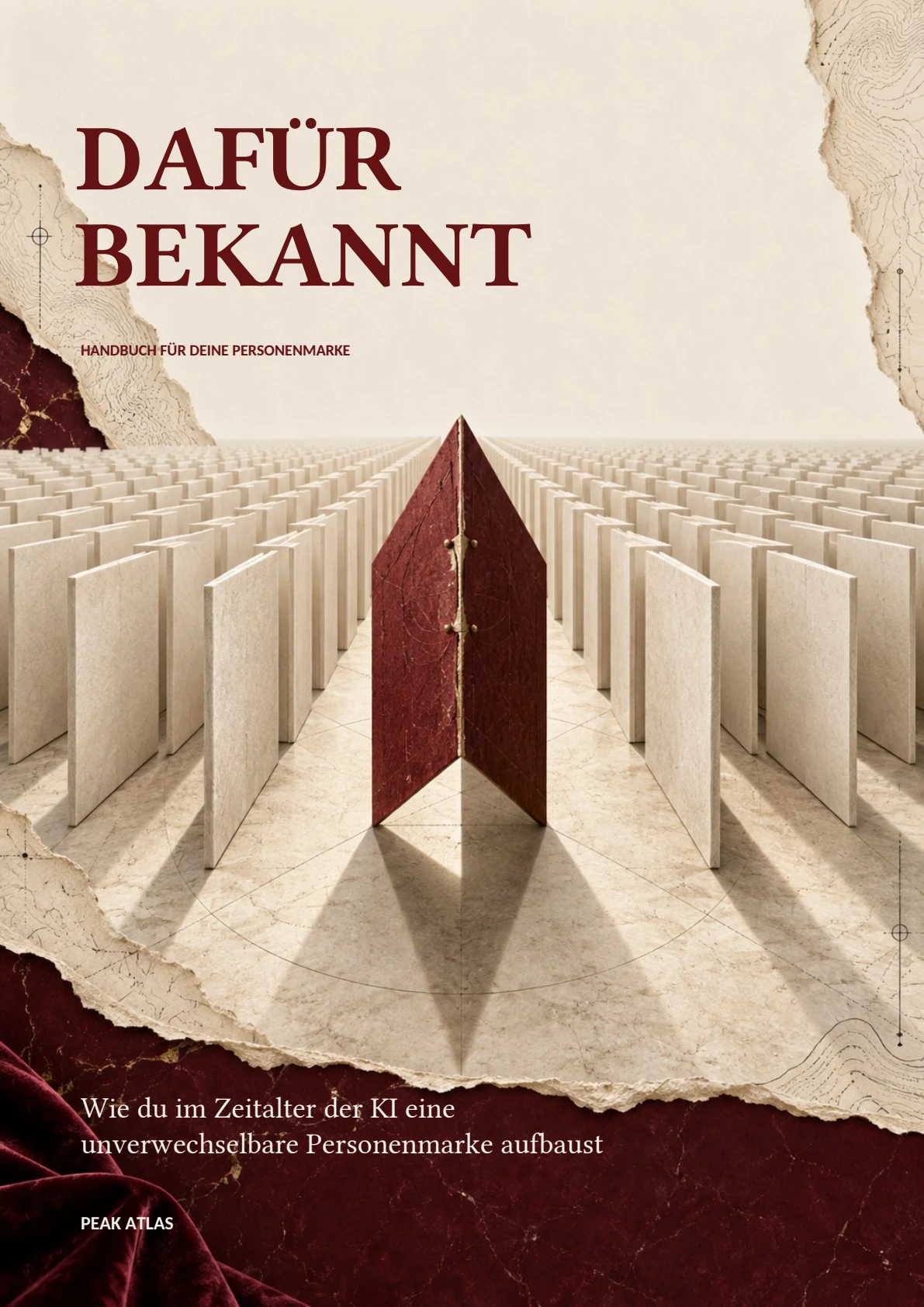
Cover of Dafür bekannt: rows of light stone tablets in a marble hall, a burgundy tablet with a brass hinge standing in the middle, framed by torn paper and map lines
Illustrated reading edition · Title page from the book

The starting point

Many are visible. Few are known for something specific.

Posts, profiles, and presentations can be generated in minutes today. What doesn't come with them: a reason to trust you in particular. Before you publish more, a different question is worth asking: what expectation should your name trigger, and how do you back it up?

The book's order

Reputation builds in a sequence: first a clear position, then a role for others, then distinctiveness, your own substance, and content that carries trust further. The eight parts of the book follow exactly this path, up to the point where reputation is translated into opportunities.

A look inside the book

Three roles, one model, one card.

The Archetype Atlas presents each role on a double-page spread: on the left, people who make it visible; on the right, brands, behavior, shadow side and limit. Plus the model page on Apple versus IBM and the brand card from the workbook – all pages complete and uncropped.

The Hero: Performance, preparation and visible action · Pages 70–71 · Archetype Atlas · Role 04
The Jester: comic characters and surprising brand communication · Pages 80–81 · Archetype Atlas · Role 09
The Ruler: Authority, status and their limits · Pages 86–87 · Archetype Atlas · Role 12

How the atlas is meant

Archetypes are editorial readings of relationship roles, not personality tests. For the Jester, Rowan Atkinson stands for his character Mr. Bean; for the Ruler, Napoleon, Anna Wintour and Elizabeth II show different expressions of authority, not a leadership model.

All image credits are listed at the bottom of the page.

Apple vs. IBM: The counter-image of a brand · Page 55 · Chapter 14 · Model and case
Your brand card on one page · Page 215 · Workbook · Brand operating system

49 case examples in the book

Examples with a concrete reference.

Each chapter works with a different case – a work, a campaign or a decision, not a name as decoration. Four of them in short form: what to observe, what you make of it and where the transfer ends.

Chapter 02 · Trust becomes scarce

Volvo

The three-point seat belt of 1959

Observation
Volvo documents the development of the modern three-point seat belt by Nils Bohlin and the release of the patent to other manufacturers. Safety becomes tangible in a single technical decision.
Why it fits
Trust needs evidence of ability and intent. A useful product and the way it gets passed on supply more material than the word “trustworthy.”

Your application

Show a decision where your claimed value changed actual performance or how you treated others.

Limit A historical article is no proof that every vehicle today is safer in every situation.

Chapter 09 · Claim a tension

Patagonia

The ad against unnecessary consumption

Observation
On Black Friday 2011, Patagonia published the ad “Don’t Buy This Jacket”. The accompanying text names the environmental cost of manufacturing and calls for more conscious consumption.
Why it fits
The conflict is concrete: people need gear and at the same time want to limit their resource consumption. Patagonia makes this tension visible.

Your application

Formulate the two legitimate wishes of your audience that often collide with each other.

Limit The ad comes from a company that sells clothing. It is not proof of consistency or of any particular environmental footprint.

Chapter 14 · The counter-image of your brand

Apple vs. IBM

The 1984 Macintosh commercial

Observation
An athlete smashes the screen of a controlling authority. The film condenses technical competition into a story about self-determination. IBM is hinted at as the competitor.
Why it fits
The counter-image is conformity; the Macintosh is meant to embody the better alternative. That gives the story a conflict and a direction.

Your application

Attack a harmful pattern and show how your work creates a concrete alternative.

Limit The film stages an adversary. It is not a neutral description of IBM or proof that Apple stands for freedom as a matter of principle.

Chapter 42 · Community as feedback

LEGO

Feedback with a defined next step

Observation
At LEGO Ideas, proposals can gather support. The documented process provides for a review by LEGO after 10,000 supporters, taking various factors into account.
Why it fits
Listening changes a decision process here: a signal from the community leads into a defined review.

Your application

Define which feedback triggers which review or change, and report the decision back.

Limit 10,000 pledges of support don't mean an automatic product release. Votes alone don't answer every question about feasibility.

Your path through the book

Eight parts, 49 chapters, each with its own case.

In the order of the book, with chapter number and book page. Search for a chapter title, an example or a number.

49 chapters · 8 parts

Reputation starts with the work you are responsible for. This part separates visibility, familiarity and trust, and shows which human contributions can become more valuable through AI.

  • 01The abundance of content · DoveS. 14
  • 02Trust is becoming scarce · VolvoS. 17
  • 03What is a personal brand? · Michael JordanS. 20
  • 04Awareness is not a goal yet · Jane GoodallS. 23
  • 05Seven human strengths · Serena WilliamsS. 26
  • 06Reputation grows with every experience · Dolly PartonS. 29

Workbook · Book pages 200–215

From position to your own work.

16 workbook pages carry the book's decisions over into a brand operating system. The brand card on page 215 condenses them onto one page – short enough to update after every review.

  1. 01Clarify your positionWho is your work relevant for, what problem does it solve, and which verb should people use to describe you? The result is a sentence you can test.
  2. 02Gather evidenceYour own work, decisions and results that back up your claim – organized, instead of asserted anew at every opportunity.
  3. 03Apply the rulebookCapture voice, signature, formats and channels as a brand rulebook that people and AI tools can use consistently.

What the card captures

Name, target audience, known for, mental verb, category, primary and secondary archetype, functional role, core conviction, counter-image, evidence, defining mental model, verbal voice, visual signature, primary and direct channel, offer and key metric.
Your brand card on one page · Page 215 · Workbook · Brand operating system

Who it's for

For everyone whose name has to carry trust.

  • Freelancers and consultants whose name is the actual offering
  • Entrepreneurs and founders who think of personal and company brand together
  • Professionals and executives who want to be recognizably associated with a topic

What you can do afterward

  • Formulate a verifiable positioning statement: for whom, which problem, which verb.
  • Choose a relationship role and know its downside, instead of asserting a personality.
  • Collect evidence that supports your claim and write a brand rulebook for people and AI.
  • Develop content systematically and translate trust into concrete demand.

Questions about the book

Briefly answered.

Illustrated reading edition

Start with the expectation your name should trigger.

244 pages · 49 chapters · 8 parts · Standalone book outside the series “The 7 Books of Money”

Sources and image credits20 image credits for the book pages shown, original sources of the four cases and notes on presentation

About the display

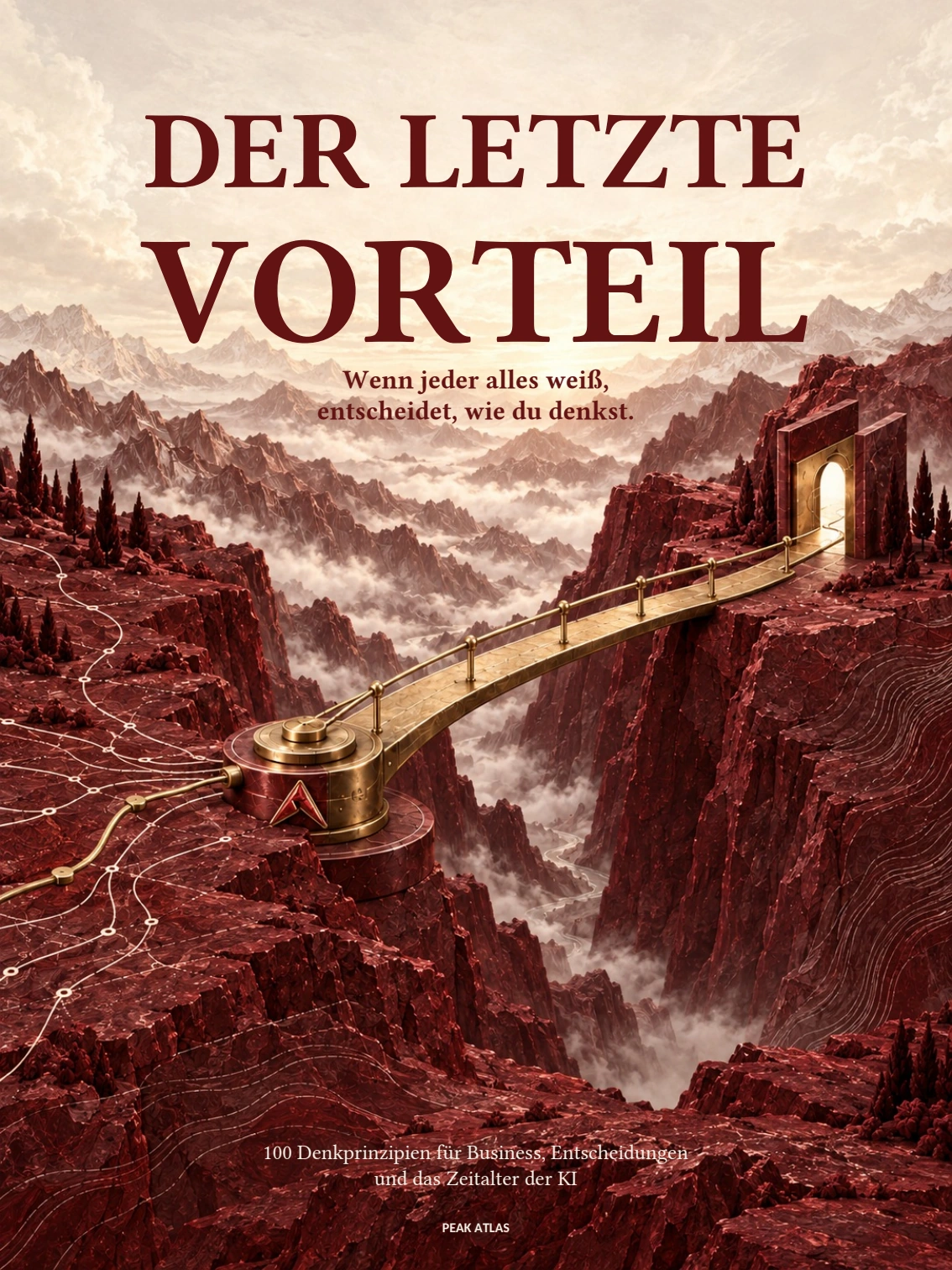
  • The cover artwork is AI-generated and part of the book's design.
  • All book pages shown are rendered proportionally and uncropped; they come from the illustrated reading edition with 244 pages.
  • The examples refer to specific works, campaigns or decisions. Archetypes are editorial readings, not personality tests. The book edition collects sources and image credits at the end.
  • The book edition collects 107 sources and all image credits at the end.

Original sources for the four cases

Image credits for the pages shown

  • adidas · LogoAdidas · Public domainSource
  • American Express · LogoPentagram Studio · Public domainSource
  • Anna Wintour · PortraitPhilipRomanoPhoto · CC BY-SA 4.0Source
  • Apple · LogoOriginal: Rob Janoff · Public domainSource
  • Charlie Chaplin · PortraitStrauss-Peyton Studio · Public domainSource
  • Elizabeth II. · PortraitDonald McKague · Public domainSource
  • Fanta · LogoThe Coca Cola Company · Public domainSource
  • IBM · LogoPaul Rand · Public domainSource
  • Jim Carrey · PortraitSHOWTIME · CC BY 3.0Source
  • M&M’s · LogoMars · Public domainSource
  • Mercedes-Benz · LogoMercedes-Benz · Public domainSource
  • Michael Jordan · PortraitDOD photo by D. Myles Cullen · Public domainSource
  • Muhammad Ali · PortraitIra Rosenberg · Public domainSource
  • Napoleon · PortraitJacques-Louis David · Public domainSource
  • Nike · LogoCarolyn Davidson, Nike · Public domainSource
  • Old Spice · LogoFair useSource
  • Rolex · LogoHans Wilsdorf · Public domainSource
  • Rowan Atkinson · PortraitEva Rinaldi · CC BY-SA 2.0Source
  • Serena Williams · PortraitAndrewHenkelman · CC BY-SA 4.0Source
  • Under Armour · LogoUnknown (Vector graphics logo by Kalel2007) · Public domainSource

Portraits and logos: unaltered original files, fitted proportionally in the book; no synthetic portraits.

Start with Clarity. The rest follows.

Sign in with Google, build your atlas in about two minutes and see your company in one place.

Free plan · Sign in with Google · set up in about two minutes