
Peak Atlas

Illustrated reading edition · Philipp Rückert

The Last Advantage

When everyone knows everything, how you think decides.

100 principles of thinking for business, decisions, and the age of AI

235 pages · PDF · approx. 79 MB

Cover of Der letzte Vorteil by Philipp Rückert

Why this book

A good answer is only the beginning of a good decision.

Knowledge is more available than ever. What stays harder is spotting the bottleneck, testing assumptions and setting the next priority. The 100 stories make principles for thinking concrete; the questions at the end apply them to your situation.

This applies to AI too: a convincing result can be helpful and still rest on a false assumption. The book helps you assess suggestions, look for counterarguments and not hand your own judgment over to a tool.

Three real excerpts

Story, principle and your question.

Principle 003

The apples don’t keep statistics

The Pareto Principle

Equal effort doesn’t yet produce equal returns.
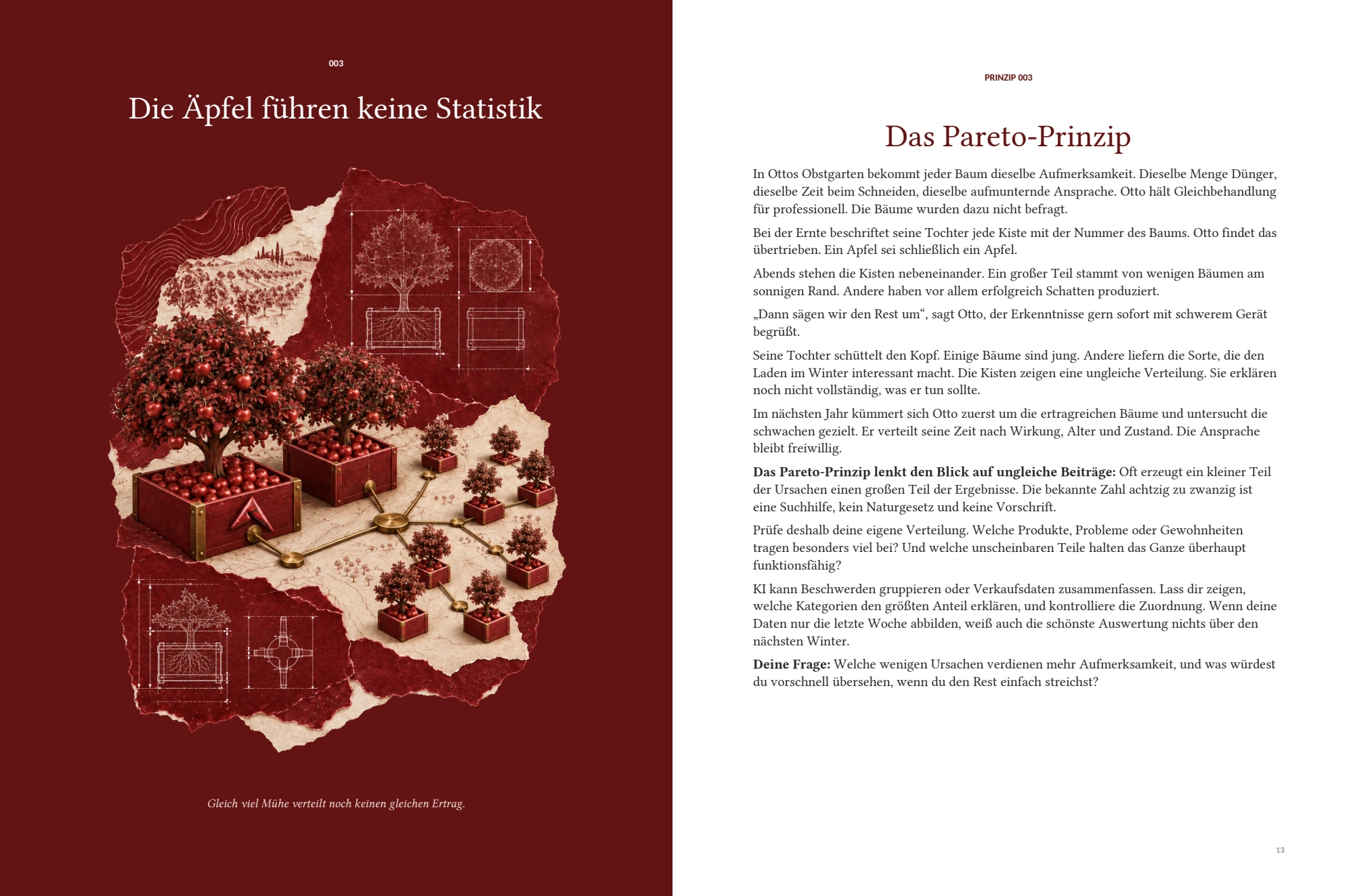
Book spread on The Pareto Principle with an apple orchard
Read the story

In Otto’s orchard, every tree gets the same attention. The same amount of fertilizer, the same time pruning, the same encouraging talk. Otto considers equal treatment professional. The trees weren’t asked.

At harvest time, his daughter labels every crate with the number of the tree. Otto finds that excessive. An apple is an apple, after all.

In the evening, the crates stand side by side. A large share comes from a few trees on the sunny edge. Others mostly produced shade, successfully.

“Then we'll saw up the rest,” says Otto, who likes to greet insights right away with heavy machinery.

His daughter shakes her head. Some trees are young. Others supply the variety that makes the shop interesting in winter. The crates show an uneven distribution. They don't yet fully explain what he should do.

Next year, Otto first takes care of the productive trees and examines the weak ones in a targeted way. He distributes his time by impact, age and condition. The pep talks remain voluntary.

The Pareto Principle directs attention to unequal contributions: Often a small share of causes produces a large share of results. The well-known eighty-twenty figure is a search aid, not a law of nature and not a rule.

So check your own distribution. Which products, problems or habits contribute especially much? And which inconspicuous parts keep the whole thing working in the first place?

AI can group complaints or summarize sales data. Have it show which categories explain the largest share, and check the assignment. If your data covers only the last week, even the nicest analysis knows nothing about next winter.

Your question: Which few causes deserve more attention, and what would you overlook too quickly if you simply cut the rest?
Principle 007

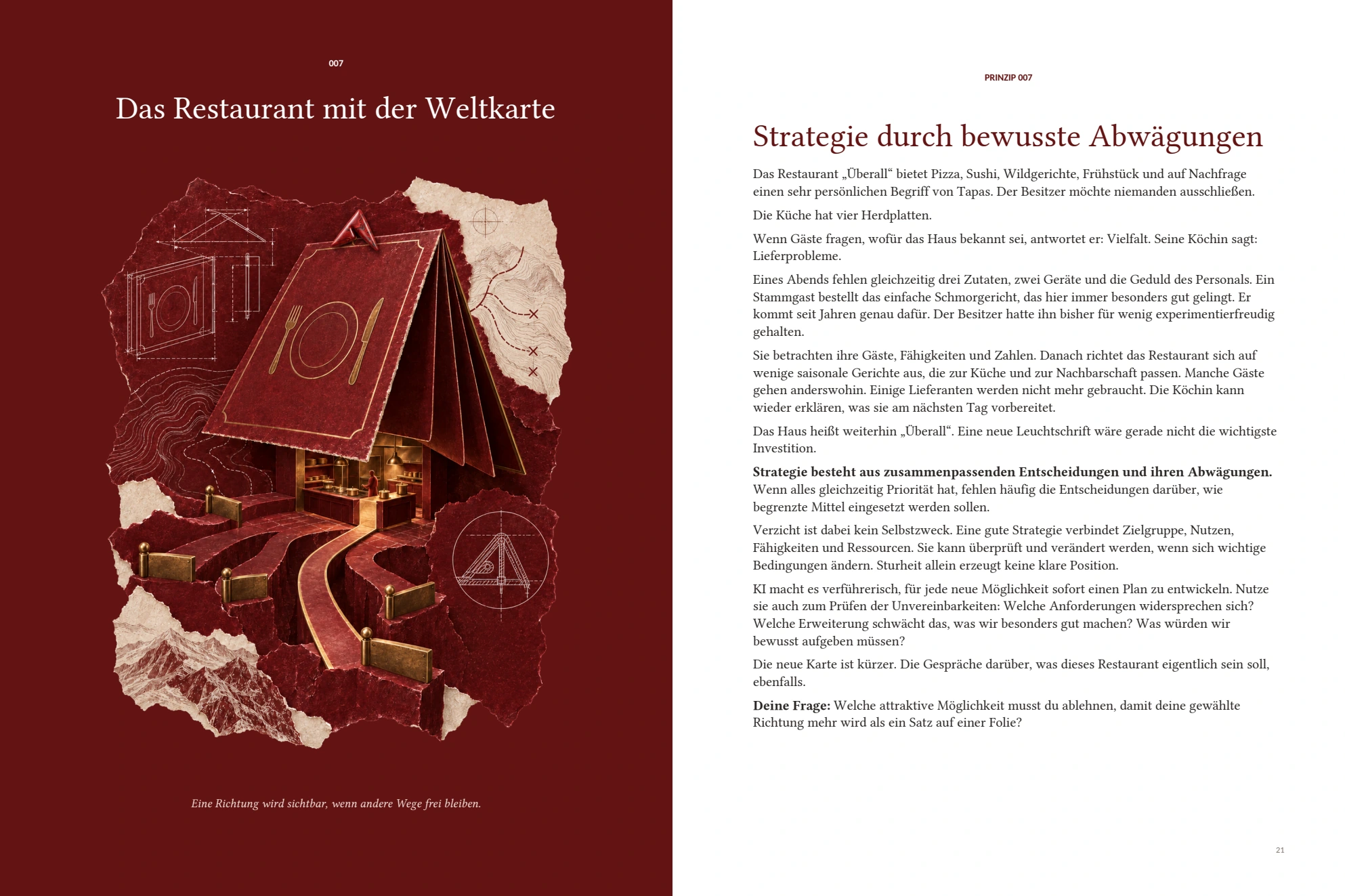
The restaurant with the world map

Strategy through deliberate trade-offs

A direction becomes visible when other paths stay open.

Book spread on strategy through deliberate trade-offs with a restaurant
Read the story

The restaurant “Everywhere” serves pizza, sushi, game dishes, breakfast and, on request, a very personal take on tapas. The owner doesn’t want to exclude anyone.

The kitchen has four burners.

When guests ask what the house is known for, he answers: variety. His cook says: supply problems.

One evening, three ingredients, two appliances and the staff’s patience are missing all at once. A regular orders the simple braised dish that always turns out especially well here. He has been coming for exactly that for years. The owner had considered him not very adventurous.

They look at their guests, skills and numbers. Afterward the restaurant focuses on a few seasonal dishes that fit the kitchen and the neighborhood. Some guests go elsewhere. A few suppliers are no longer needed. The chef can once again explain what she's prepping for the next day.

The house is still called “Everywhere”. A new neon sign would hardly be the most important investment.

Strategy is made of decisions that fit together, and their trade-offs. When everything has priority at once, decisions are often missing on how limited resources should be used.

Giving things up is not an end in itself. A good strategy connects audience, benefit, capabilities and resources. It can be reviewed and changed when important conditions change. Stubbornness alone does not create a clear position.

AI makes it tempting to develop a plan right away for every new opportunity. Use it also to check for incompatibilities: Which requirements contradict each other? Which expansion weakens what we do especially well? What would we have to knowingly give up?

The new menu is shorter. So are the conversations about what this restaurant is actually supposed to be.

Your question: Which attractive option do you have to turn down so your chosen direction becomes more than a line on a slide?

Principle 040

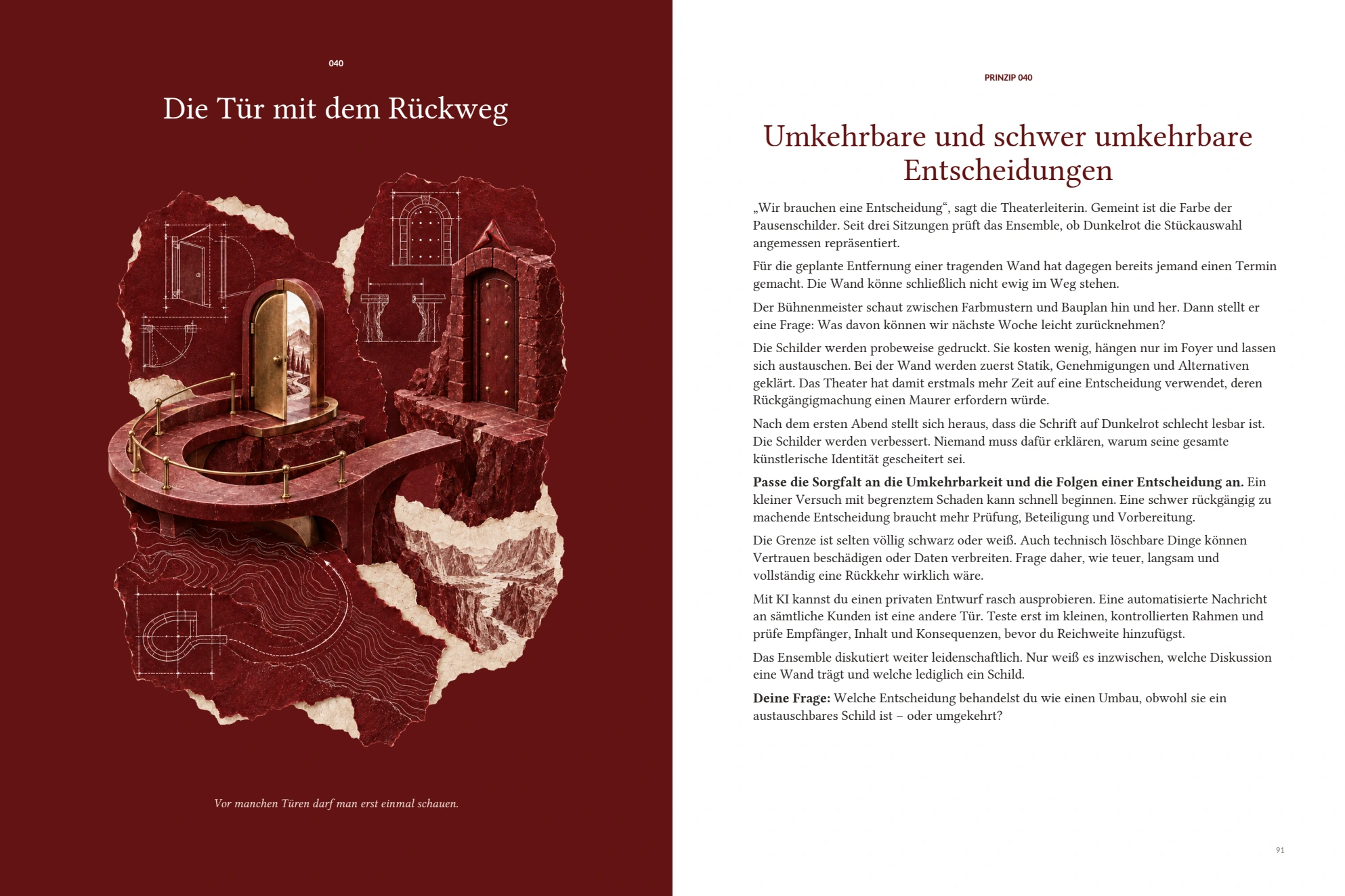
The door with a way back

Reversible and hard-to-reverse decisions

Behind some doors, you're allowed to look first.

Book spread on reversible decisions with a door
Read the story

“We need a decision,” says the theater director. She means the color of the intermission signs. For three sessions the ensemble has been checking whether dark red appropriately represents the choice of plays.

For the planned removal of a load-bearing wall, however, someone has already made an appointment. The wall can’t stand in the way forever, after all.

The stage manager looks back and forth between color swatches and the construction plan. Then he asks a question: Which of this can we easily take back next week?

The signs will be printed on a trial basis. They cost little, hang only in the foyer and can be swapped out. For the wall, structural engineering, permits and alternatives are clarified first. The theater has thus, for the first time, spent more time on a decision whose reversal would require a bricklayer.

After the first evening, it turns out the lettering on dark red is hard to read. The signs get fixed. Nobody has to explain why their entire artistic identity has failed.

Match the level of care to how reversible a decision is and what follows from it. A small experiment with limited damage can start quickly. A decision that is hard to undo needs more review, involvement and preparation.

The line is rarely completely black or white. Even things that can technically be deleted can damage trust or spread data. So ask how costly, slow and complete a return would really be.

With AI, you can quickly try out a private draft. An automated message to all your customers is a different door. Test first in a small, controlled setting and check recipients, content and consequences before you add reach.

The ensemble keeps debating passionately. But it now knows which discussion holds up a wall and which merely holds up a sign.

Your question: Which decision are you treating like a renovation when it's really a replaceable sign – or the other way around?

Eight parts · 100 principles

From effective action to thinking in years.

How to read the book

Three ways to apply a principle.

01

From the start

Read the eight parts in order and follow the path from impact through decisions and collaboration to systems thinking.

02

Look things up

Start with a current decision and choose the principle that lets you examine your assumption, priority or way back more closely.

03

Discuss as a team

Read a spread together and answer the closing question from different roles.

Frequently asked questions

Briefly answered.

The complete reading edition

235 pages · 100 principles for thinking

PDF · approx. 79 MB

Start with Clarity. The rest follows.

Sign in with Google, build your atlas in about two minutes and see your company in one place.

Free plan · Sign in with Google · set up in about two minutes