Leading & scaling · Field Manual · Illustrated reading edition
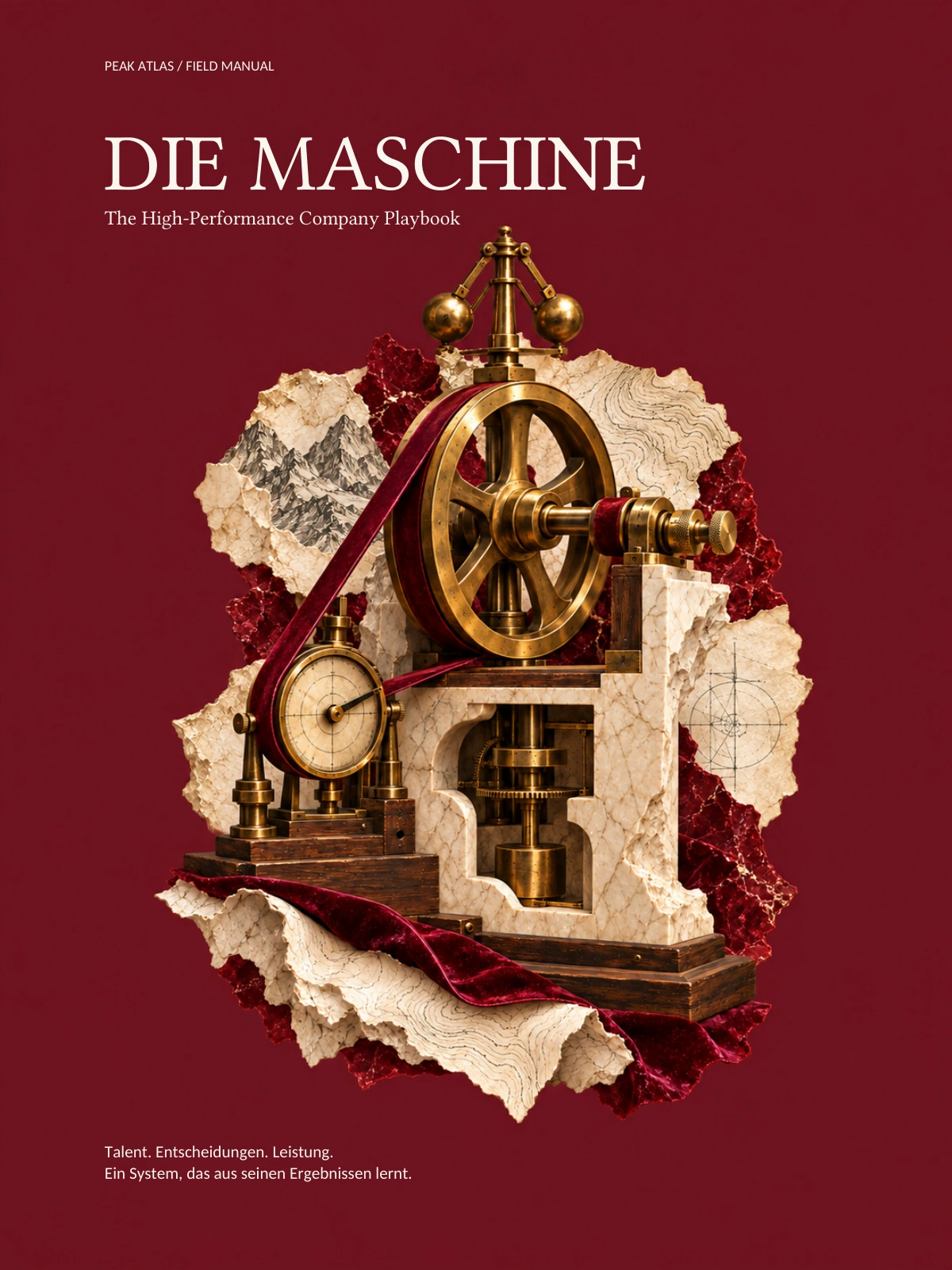
The Machine
The High-Performance Company Playbook
Build a company that learns from its results.
Select talent. Make performance visible. Hand off decisions. The Machine connects twelve building blocks into a loop that works in everyday life – with clear standards, concrete tools and room for your case.
Philipp Rückert
- Pages
- 62
- Modules
- 12
- Tools
- 24
- Illustrations
- 22
The starting point
Many companies work hard. Few learn from what comes out of it.

Unclear standards, waiting time between decisions, and leadership that every approval hangs on: these aren't character flaws but system flaws. Die Maschine starts where measurement actually changes the next deployment of people, time, and capital.
The learning loop
Benefit first, then tool
Three typical frictions become concrete decisions.
- 01
Unclear standards
The standard is recorded before a candidate or a result is evaluated.
Tools: Role Scorecard · Bar Raiser Protocol · Three dimensions. Nowhere to hide.
- 02
Wait times between decisions
Every important decision gets exactly one owner with limited leeway.
Tools: Speed Audit · One decision. One owner.
- 03
Dependence on the founder
Results are handed over with purpose, limits, resources and review date.
Tools: Ownership contract · Founder Ownership Map

Look inside the playbook
Three modules, one template, the wrap-up.
Each module opens with a double-page spread: on the left the motif and the guiding principle, on the right scene, principle, effect, system, breaking point and the first step. The pages shown are complete and uncropped – with the actual page numbers of the edition.
Module 05 · Principle and tool
A precise standard needs fewer adjectives.
The QuantumLight framework looks at deliverables, skills and culture separately. This separation is central: a lot of output must not simply offset a serious behavioral shortcoming arithmetically.
For deliverables, the original distinguishes speed, quality and complexity. The published formula is: [Speed + Quality] × Complexity. Skills and culture are additionally checked against explicit standards. The formula alone is therefore not an overall judgment of a person.
The rule
Your path through the playbook
Twelve modules, two tools each.
In the order of the book, with guiding principle, book pages and the 24 module-specific tools. Each module can be expanded individually.

A company gets better when its feedback gets better.
Tool · Page 8
The Machine Map
Use the map for one specific business flow. Edit it with the person who owns the result. Duration: 45 minutes.
Tool · Page 9
The smallest system contract
Don’t install a full corporate architecture. For one process, capture on one page what becomes binding.

The standard comes first
30-day installation
A first loop in thirty days.
The installation promises a first verifiable loop – not a complete company transformation. Five stages, each with a named result.
- 01
DAY 01–03 · Diagnosis
Fill out the Machine Map and Machine Check. Pick one specific bottleneck. Result: one business flow, one owner, one measurable baseline.
- 02
DAY 04–07 · Benchmark
Write the scorecard for one critical role. Have a work sample assessed independently. Result: shared minimum standards instead of just new forms.
- 03
DAY 08–14 · Authority
Hand over a result with room for decisions. Remove the longest avoidable wait. Result: a tested ownership contract.
- 04
DAY 15–21 · Evidence
Start one limited initiative with scale/hold/kill rules. Correct one problematic KPI. Result: a trial with a clear review and quality limit.
- 05
DAY 22–30 · Feedback
Carry out a review of the installation. Check impact, side effects and effort. Keep, adjust or remove. Result: a small, working loop.
Machine Check · Self-assessment
How well does your company learn today?
Rate each dimension from 1 to 5 based on a concrete example from the last 90 days. The total appears as soon as all 9 questions are answered. Nothing is saved or transmitted.
1 = barely present · 2 = occasionally · 3 = repeatable · 4 = consistently with evidence · 5 = reviewed and continuously improved

Your result
Answer all 9 questions and the total between 9 and 45 appears with its classification.
- 9–15: Fundamentals missing
- 16–25: Highly dependent on individuals
- 26–35: Repeatable processes
- 36–40: Consistent management
- 41–45: High self-reported maturity; still to be verified externally
Unvalidated self-assessment. No data storage, no transmission.

Who it's for
For everyone who wants to make a company less dependent on individuals.

Founders and management teams who want to make their company less dependent on individuals
Team leads who manage hiring, performance, and responsibility by clear standards
Leadership teams that speed up decisions without leaving quality to chance
What you can do afterward
- Describe a concrete business flow with an owner, a standard, and feedback.
- Hire on evidence and fix the role standard before the favorite candidate.
- Assess results, ability, and behavior separately and explain performance judgments with evidence.
- Hand over decisions with authority and tie new resources to verifiable evidence.
Questions about the playbook
Briefly answered.
Read next
Related perspectives.

Standalone book
Work Without Chance
A full day isn't yet an effective day. This visual atlas helps you choose the right tasks, cut what's superfluous, and reliably finish important work.

Standalone book
The Last Advantage
100 principles of thinking, short stories, and questions for business, decisions, and the age of AI.

Standalone book
Sales ohne Zufall
More leads. A new CRM. Another training. And the same bottleneck still sits comfortably in the pipeline. Find out where your sales gets stuck, and what you can concretely change.
Illustrated reading edition · Conclusion
The next decision is the beginning.
A clear first deployment is enough to start. Progress is a provable change – not a fully completed playbook.
- 01
Choose a real bottleneck.
A decision that stalls. A standard that's missing. A result nobody feels responsible for. Name one concrete case.
- 02
Agree on the smallest intervention.
One owner, one usable result, one limit and one date. Choose the tool that makes this agreement easier.
- 03
Check the next effect.
What changed? What did it cost? What side effect arose? Record what you keep, change or remove.


62 pages · 12 modules · 24 tools · Standalone playbook outside the series “The 7 Books of Money” · Philipp Rückert