The SOP Playbook · Peak Atlas
Processes your team actually runs.
The 80/20 System for Building Processes People Actually Follow
Recurring work needs a clear start, verifiable steps and a visible result. This playbook shows you how to turn that into a short SOP – and test it with your team in daily work.
Illustrated reading edition · Edition 1.1 · September 2026 · Publisher Peak Atlas
- Pages
- 62
- Chapter
- 10
- Illustrations
- 16
- Output
- 1.1
Why this playbook
Three reasons why processes fail in everyday work.
The yardstick is not the documentation but the observed execution. The playbook starts exactly there.
01
Knowledge lives in individual heads.
An SOP makes the start, responsibility and result visible to the next person.
02
Documented doesn't mean executable.
An observed test shows where steps, prerequisites or decisions are missing.
03
Errors need a clear path.
Checks, stop conditions and escalation belong in the workflow.
The model · Chapter 04
One SOP. Three views.
The executor needs less information than the process owner. That's why the playbook separates an SOP into Run, Control, and Learn, and bundles templates and sources in Resources.
ARun
What do I have to do now?
Quick Info, Start Gate, DO / CHECK / IF FAILED and Done. The view opened in the moment of work.
BControl
Does the process work?
Responsibility, measurement points, failure paths and changes. The process owner's view.
CLearn
Can I run it on my own?
Context, examples and observed practice. The view that builds skill.
DResources
The supplementary section for linked templates and authoritative sources – not a fourth execution layer. Simple process? Stop after A. Every additional layer must serve a concrete purpose.
Teaching example in the book
Using incoming invoices as an example, the playbook shows how a trigger, a start gate, a few DO/CHECK steps, and a clear done condition turn into a short, testable SOP. It's a teaching example, not a customer result.
The principle
An SOP is only usable once another person can carry it out and check the result.
Real previews
Five pages from the finished edition.
Three chapter spreads and two templates from the appendix – rendered directly from the final PDF. Tap or click a page to open it in full resolution and zoom in.
Pages 12–13
A path with built-in checks
Chapter 03 · Trigger, Gate, Do, Check and the safe failure path: only passed critical checks lead to Done.
Pages 22–23
One SOP. Three views.
Chapter 04 · Run, Control and Learn: the executor needs less information than the process owner.
Pages 38–39
Write the first usable draft
Chapter 07 · The 30-minute work box in six steps – from selecting the process to preparing the test.
Page 55
A · Quick Run: copy template
Appendix A · Quick Info, Start Gate, Stop Conditions, DO / CHECK / IF FAILED and Definition of Done as a template.
Page 58
The audit sheet
Appendix C · Twelve checkpoints with 0/1/2 scoring, finding and deployment decision – as an A4 print template.
How it works
From first draft to a tested workflow.
Five steps played through in the playbook from chapter 07 to chapter 10 – with work box, test and approval.
Honest limits
30 minutes is the work box for a first draft – not a guarantee of an approved or safe SOP. The 7-Day SOP Sprint is a guiding rhythm for manageable processes.
- 1
Select a process
A recurring workflow with a clear scope.
- 2
Observe the real workflow
Notes from a real run instead of an invented ideal process.
- 3
Write a short working version
Trigger, Done, a few main steps with DO / CHECK / IF FAILED, stops and escalation.
- 4
Test with a second person
A suitable person runs the SOP in a safe test environment.
- 5
Improve and approve responsibly
Close the gaps, re-check the affected check and name the approval.
Contents
Ten chapters. From trigger to approval.
Each chapter opens with a full-page illustration and leads from principle and example to a concrete working rule. In German, with some English technical terms.
- 01S. 4
Why SOPs don't work
Use and observed execution as the yardstick.
- 02S. 8
What does an SOP need?
Use repetition, risk, and handoffs for prioritization.
- 03S. 12
The anatomy of a good SOP
From trigger through checks to a verifiable end state.
- 04S. 22
The three layers
Execute, steer, and learn in suitable views.
- 05S. 28
Write less, control more
Shorten without losing important decisions and stop rules.
- 06S. 32
Quality without bureaucracy
Choose controls that match the risk.
- 07S. 38
Draft an SOP in 30 minutes
Write a short first working version from a real workflow.
- 08S. 44
The SOP audit scorecard
Check weak points and identify the next improvements.
- 09S. 48
The first five SOPs
Choose a small, sensible starter portfolio.
- 10S. 52
The 7-Day SOP Sprint
Observe, draft, test, and refine in a manageable rhythm.
To apply
Four tools for the first field test.
The finished work package includes these four tools alongside the playbook. On this page we show previews; we discuss the package itself in a conversation.
You can try the SOP structure itself right away: To the SOP workshop
Editable Markdown
A/B/C/D SOP template
Quick Run, Control, Learn, and Resources as a fillable structure for your first working version.
CSV · 20 rows
Process inventory
Collect recurring workflows and prioritize them by repetition, risk, and handoffs.
A4 print template
SOP cheat sheet
The anatomy of an SOP on one page, for the desk or the test run.
A4 print template
SOP audit sheet
Twelve checkpoints with findings and a usage decision, printable, not fillable digitally.
SOP Workshop · Peak Atlas
Knowledge that
holds up in daily work.
Turn the knowledge in your head into a clear process for your team. With responsibilities, verifiable steps, and an unambiguous result.
- No login required
- Fill in directly
- Exportable as a draft

As much structure as needed
One SOP.
Four clear sections.
For a simple process, A is enough. You add control, training, and sources when they become relevant to your daily work.

The process.
Clear to everyone.
What to do. What must be true. When it's done.
Accountability.
With oversight.
Roles, metrics, and rules for the people who run the process.
 C
CPass on
knowledge.
Training and onboarding for new people carrying out the process.
DSources
at hand.
Templates, documents, and authoritative references.
A · Quick Run
A process your team can take over.
Start with the frame. Then come start conditions, steps, and a clear completion.
Audience: Person performing the work · Purpose: Complete the process correctly with minimal reading and minimal decisions.
Accountability
Who takes over?
Prerequisite → result
02 · Start gate
Get ready first. Then go.
Define what must be true before every run. You can adapt the generic rules to your process.

03 · Stop & escalation
This is where you stop.
A clear process also makes its limits visible: when you stop, whom you inform, and how to proceed safely.
04 · Execution
One step. One clear result.
Describe the action, the objective check, and the safe response to failures. Add extra steps as needed.
05 · Completion
Done means it's right.
Make visible which criteria must be met and which evidence must be filed.
Stop rule: if this is a simple SOP, A is enough. Only continue with B/C if control, compliance, training or audits are relevant.
If your process needs more
The right depth. For every role.
Audience: SOP owner, process owner, manager, reviewer · Purpose: Monitor process health, manage risk, check metrics and improve the process.
Publishing rule: a new version only becomes active once the change has been approved, area A tested, the impact on metrics checked, training updated, affected roles informed and the previous version archived.
Audience: New, rotating or not yet approved performers · Purpose: Build the ability to carry out the SOP independently and correctly.
Purpose: Linked templates and authoritative sources – not a fourth execution level.
Preview · exactly this text is copied, downloaded, and printed
sop-entwurf.md# SOP Draft: To be defined **Status:** Working draft – test in a real workflow and approve **Created on:** October 11, 2026 · local in the browser, no storage or transmission **Source:** Interactive web template based on the Peak Atlas SOP structure (The SOP Playbook). Not an original document, not a customer result. --- ## A. Quick Run **Audience:** Person executing the process **Purpose:** Complete the process correctly with minimal reading and minimal decisions. ### Process name To be defined ### Start (trigger) To be defined ### Done To be defined ### Needs (inputs) To be defined ### Produces (output) To be defined ### Executing role To be defined ### Stop / escalation – warning signal To be defined ### Escalate to (role) To be defined ### Escalate within (deadline) To be defined ### Typical duration To be defined ### Start gate – do not begin until all conditions are met - [ ] The valid trigger is present - [ ] All required inputs are available - [ ] Customer, company, project or record is clearly identified - [ ] Required access and permissions work - [ ] No stop condition applies - [ ] A new execution log has been created and linked to this SOP version ### Start gate not met – response Do not start. Document the missing condition, create or link the required action, and escalate to the defined escalation role within the defined deadline. ### Stop conditions – stop immediately and do not continue if … - An irreversible action could be wrong - A required approval is missing - Amount, scope, identity or data contradict the authoritative source - The same transaction or action may already have been completed - There is a legal, security, privacy, financial or customer risk - A required system is unavailable and there is no approved fallback ### Stop procedure Secure the state · document the problem · attach evidence · escalate to the defined role · continue only after documented approval. ### Steps – Do · Check · If failed _Step: To be defined_ ### Definition of Done – only done when … - [ ] The required primary output has been produced - [ ] Every required step has passed its quality check - [ ] No unresolved stop condition remains open - [ ] The system of record has been updated - [ ] Required evidence has been filed and linked - [ ] Required approval has been documented - [ ] Affected people or systems have been informed - [ ] Follow-up task or handoff has been created, where needed - [ ] The result of the execution has been recorded - [ ] The execution log has been closed ### Closing rule Result per run: Passed · Passed with exception · Failed · Stopped. Required evidence: final output · execution log · approval · deviation note if needed · follow-up action if needed. ### Closing evidence and result (specific) To be defined > Stop rule: If this is a simple SOP, A is enough. Only continue with B/C if governance, compliance, training or audits are relevant. --- > Optional sections not filled in: B. Control Rules, C. Training & Context, D. Resources. --- --- _Working draft – test in a real workflow and approve_
Your draft. Your next step.
From your head. Into your system.
Export your SOP, test it together with your team, and then record the approved version.
Working draft – test in a real workflow and approve. Your entries stay in this tab and are not saved or transmitted. Export them before reloading or closing. The template contains generic patterns that you adapt to your process.
We discuss the complete work package with the playbook and the four tools in a conversation. Analyze my shop
Who it's for
For everyone who wants to hand off work.
For entrepreneurs, team leads and operations managers who want to hand off recurring work and have it carried out reliably.
- Entrepreneurs who want to hand off recurring work without checking every execution themselves
- Team leads and operations managers who need workflows that can be executed reliably
- Beginners with a first SOP and teams with documents that are too long or barely used
Questions about the playbook
Briefly answered.
Standalone Peak Atlas playbook. Edition 1.1 · September 2026.
Read next
Related perspectives.
Standalone book
Work Without Chance
A full day isn't yet an effective day. This visual atlas helps you choose the right tasks, cut what's superfluous, and reliably finish important work.
Standalone book
The Machine
Select talent. Make performance visible. Delegate decisions. Die Maschine connects twelve building blocks into a cycle that works in everyday life.
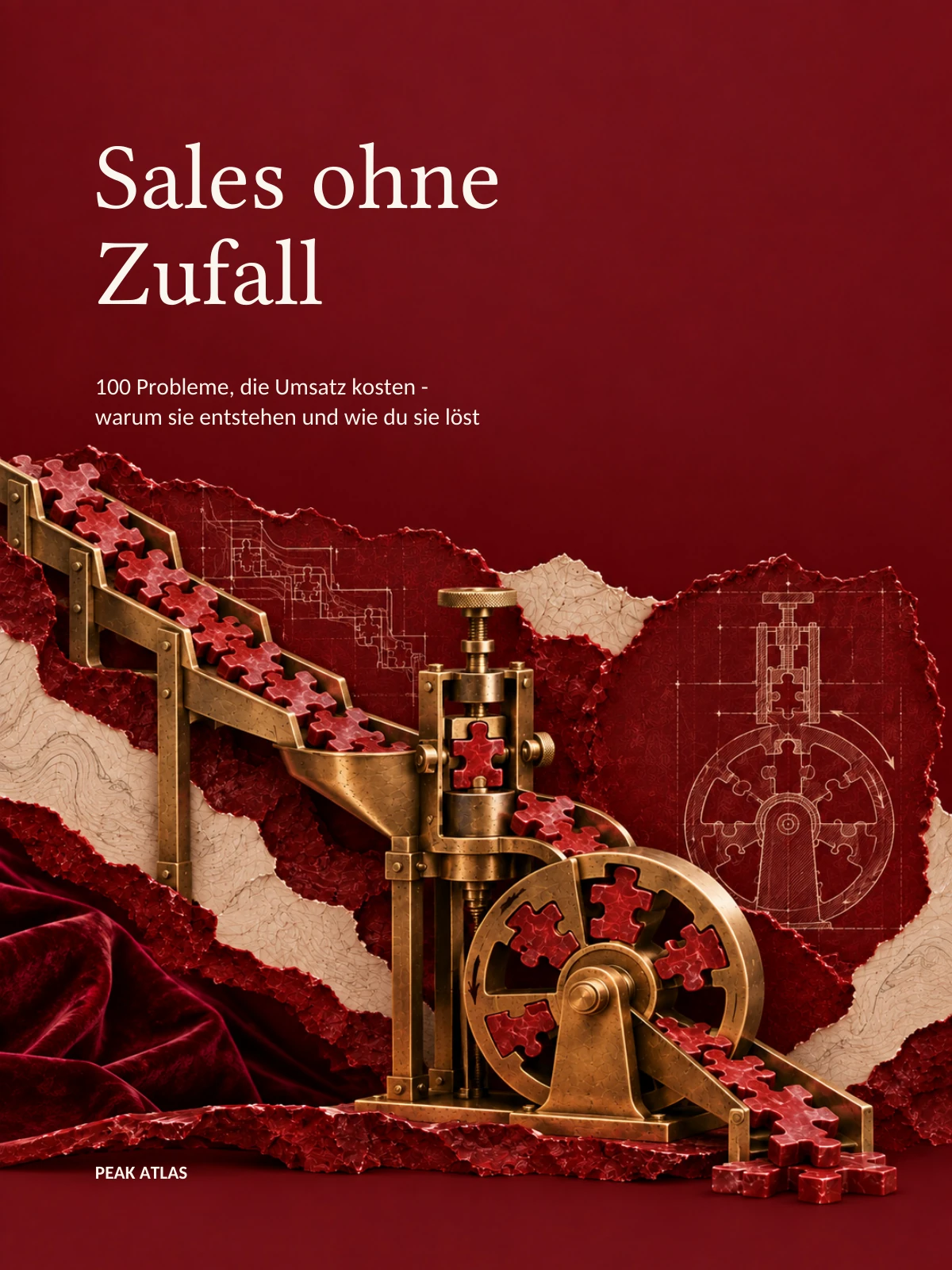
Standalone book
Sales ohne Zufall
More leads. A new CRM. Another training. And the same bottleneck still sits comfortably in the pipeline. Find out where your sales gets stuck, and what you can concretely change.
Next step · Issue 1.1 · September 2026
Write. Run. Improve.
If you want to use the playbook for your team or set up your first SOPs together with us, get in touch. In the initial consultation, we clarify which workflow deserves an SOP first.
62 pages · 10 chapters · 16 illustrations · Illustrated reading edition · Publisher Peak Atlas · Standalone playbook outside the series “The 7 Books of Money”